Short answer: on most of the Eastside, yes. Bellevue, Redmond, Issaquah, Sammamish and Mercer Island all require a permit to remove a healthy tree above their size threshold. Kirkland lets you take a few a year with a notification form, and Newcastle lets you remove up to nine significant trees without a clearing permit.
Every Eastside city writes its own tree code, and they are not close to identical. What counts as a regulated tree, how many you can remove, what you have to replant and what happens if you skip the paperwork all change at the city line. Use the checker below for a quick answer, then read your city’s section for the details.
Does your tree need a permit?
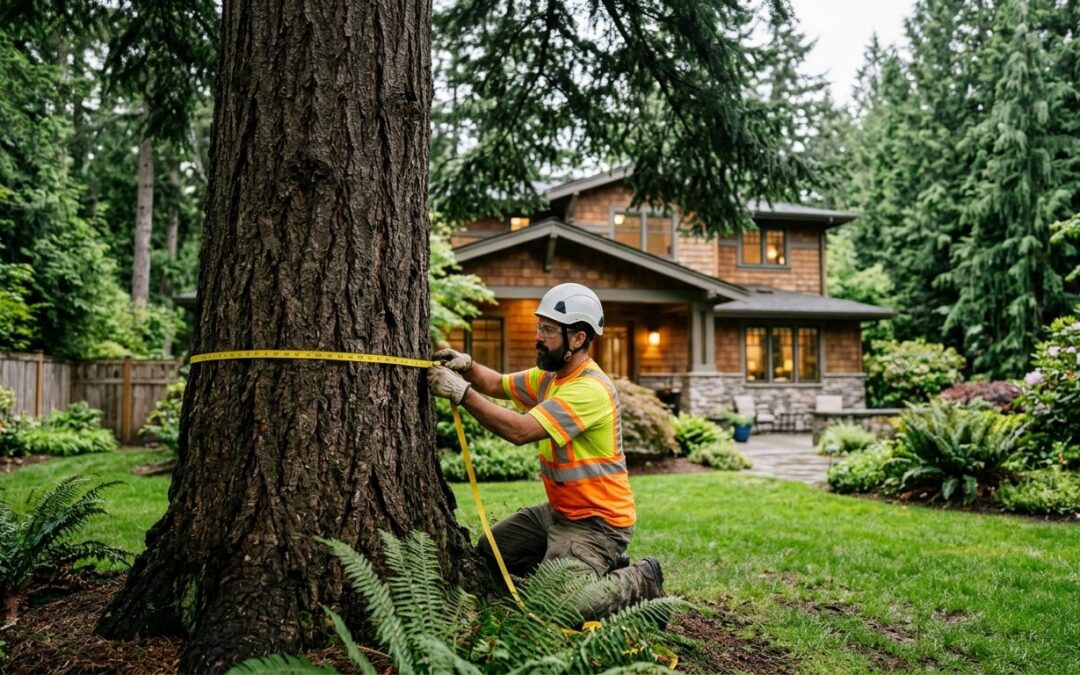
Wrap a tape measure around the trunk 4½ feet above the ground, then pick your city and the type of tree.
A quick guide, not a permit decision. Dead or hazardous trees, critical areas (slopes, streams, wetlands), trees a past development required you to keep, and multi-trunk trees can all change the answer.
The Eastside at a glance
The biggest difference between cities is whether you need a permit for a healthy tree at all.
| City | Regulated from | Permit for a healthy tree? | Yearly limit | Replanting |
|---|---|---|---|---|
| Bellevue | 6″ (landmark 24″) | Yes, always | 2–4 significant or 1 landmark before replanting, by lot size | 1:1; 3:1 for landmark |
| Kirkland | 6″ (landmark 26″) | Notification form inside the allowance; permit beyond it and for any landmark | 2, 3 or 4 per 12 months by lot size | Required on permitted removals |
| Redmond | 6″ (landmark over 30″) | Yes, always | 2, 4, 6 or 8 per year by lot size | 1:1; 3:1 for landmark |
| Issaquah | 6″ (alder and cottonwood 8″; landmark over 30″) | Yes, and only for a listed reason | No yearly allowance | 1:1 with equal canopy; 2:1 for landmark |
| Sammamish | 8″ conifer, 12″ leafy | Yes, always | 2 to 10 a year by lot size, with 10-year caps | 1 per tree; 2 heritage; 3 landmark |
| Newcastle | 8″ evergreen, 12″ leafy | No, for up to 9 significant trees on a lot not under permit review | Permit needed at 10 or more | Required when 10 or more are removed |
| Mercer Island | Over 10″ | Yes | None stated in the code | Scales with the size of the tree |
Bellevue tree removal permits
Bellevue rewrote its tree code in 2024 and has amended it several times since, most recently in 2026. A permit is required for any significant or landmark tree. In the city’s own words, “a permit is still required to remove trees within the annual limit.” The yearly allowance decides whether you have to replant, not whether you need a permit. Find your local crew on our Bellevue tree service page.
Which trees Bellevue regulates
A significant tree is a viable tree at least 6 inches in diameter at breast height (LUC 20.50.046). Before the 2024 rewrite the threshold was 8 inches, so younger trees that used to be exempt may now need a permit. A landmark tree is at least 24 inches (LUC 20.50.032), and a few slow-growing natives qualify much smaller:
| Species | Landmark at |
|---|---|
| Pacific madrone | 8 inches |
| Cascara | 8 inches |
| Pacific yew | 8 inches |
| Shore pine / lodgepole pine | 12 inches |
| Oak (any species) | 12 inches |
| Red alder | Never a landmark |
| Black cottonwood | Never a landmark |
| Everything else | 24 inches |
Bellevue measures diameter 4½ feet above the highest point of ground touching the trunk (LUC 20.50.016), so on a slope you measure from the uphill side. A circumference of about 19 inches means a significant tree; about 75 inches means a landmark. For a tree that splits into several trunks near the ground, the code squares each trunk’s diameter, adds them and takes the square root: two 5-inch stems make a tree of about 7 inches.
The yearly allowance on residential lots
Bellevue lets you remove a set number of trees in any 12-month period before replanting kicks in, as long as a minimum number of protected trees stays on the site (BCC 23.76.060, Table G):
| Lot size | Removal before replanting is required | Trees that must remain |
|---|---|---|
| Up to 10,000 sq ft | 1 landmark or 2 significant | 2 |
| 10,001–20,000 sq ft | 1 landmark or 3 significant | 3 |
| 20,001–40,000 sq ft | 1 landmark or 4 significant | 4 |
| 40,001 sq ft or more | 1 landmark or 4 significant | 8 |
Taking one landmark tree uses the whole year’s allowance. And on a small lot with only three protected trees, removing two can leave you below the minimum, which triggers replanting even though you are inside the count.
Replanting, slopes and penalties
- Replanting: one new tree per significant tree, three per landmark (or two large conifers the city approves). Replacements must be at least 2 inches caliper (leafy) or 6 feet tall (conifer). Our tree planting crew sizes and places replacement stock so it actually establishes.
- Critical areas: on a steep slope, stream, wetland or shoreline, or the buffer around one, the allowance does not apply. Bellevue’s critical areas code (LUC 20.25H) governs and is considerably stricter.
- Heavy pruning: removing more than a quarter of a protected tree’s live crown within three years needs a permit.
- Penalties: per tree, the greater of the city’s in-lieu fee or the tree’s appraised replacement value under the Guide for Plant Appraisal (BCC 1.18.045). Each tree is a separate violation, and repeat violations can be doubled. Trees on public property or in the right-of-way: three times the appraised value.
Official sources: City of Bellevue: Tree Removal · BCC 23.76.060 · LUC 20.50.046
Kirkland tree removal permits
Kirkland is the most flexible of the larger Eastside cities for a homeowner removing one or two healthy trees. Find your local crew on our Kirkland tree service page.
- Regulated tree: at least 6 inches in diameter, measured 4½ feet above average grade, and not on the city’s Prohibited Plant List. A landmark tree is 26 inches or more (KZC 95.10).
- Topping counts: topping that removes more than 25% of the live crown is treated as removal.
The notification allowance
On a developed lot, you can remove a limited number of regulated trees per 12 months by submitting a tree removal notification form, with no permit (KZC 95.25):
| Lot size | Removals per 12 months | Regulated trees that must remain |
|---|---|---|
| Up to 10,000 sq ft | 2 | 2 |
| 10,001–20,000 sq ft | 3 | 3 |
| 20,001 sq ft or more | 4 | 4 |
You need a full tree removal permit to go beyond that table, for any landmark tree, and for trees in wetlands, streams, their buffers, landslide hazard areas, shoreline setbacks or the Holmes Point Overlay. The same applies to trees a past development or a preservation covenant required you to keep. Landmark trees are limited to one per 12 months, and no more than two in any 24 months.
Mr. Hamilton and his team removed our three pine trees (Kirkland), even helping us with the permit process.
Jason C., Google review, September 2026
Official sources: City of Kirkland: Trees · KZC 95.25 · KZC 95.10
Redmond tree removal permits
Redmond requires a permit before you remove any significant tree on a developed single-family lot, even a healthy one (RZC 21.72.020). Find your local crew on our Redmond tree service page.
- Significant tree: 6 inches in diameter or more. A landmark tree is over 30 inches.
- Yearly limits: 2 trees a year on lots up to 10,000 sq ft, 4 on 10,001–20,000, 6 on 20,001–30,000, and 8 on lots over 30,000. Hazardous, dead or otherwise dangerous trees do not count toward the limit.
- Replanting: one new tree per significant tree and three per landmark, at least 2.5 inches caliper (leafy) or 6 feet tall (evergreen). Hazardous and dead trees are exempt.
- Hazard trees: the city reviews a hazard tree declaration before removal, backed by a certified arborist’s ISA Basic Tree Risk Assessment.
Redmond is rewriting its tree code. A Planning Commission hearing was set for October 14, 2026, with Council adoption expected in early 2027, so these numbers may change.
Official sources: RZC 21.72.020 · City of Redmond: Tree Code Update
Issaquah tree removal permits
Issaquah is the tightest Eastside city on healthy trees: there is no yearly allowance, and a permit is granted only for a listed reason (LUC 18.812.050). Find your local crew on our Issaquah tree service page.
- Significant tree: 6 inches or more; red alder and black cottonwood at 8 inches. A landmark tree is over 30 inches.
- Accepted reasons: a nuisance tree; a dead tree; a dying or diseased tree with an arborist’s written recommendation; a King County noxious weed species; thinning a heavily wooded area on an arborist’s advice; solar access for an active solar system; a sight-line or traffic hazard that pruning cannot fix; or wildfire risk backed by a formal assessment.
- Replanting: at least one tree per tree removed, with equal or greater canopy, and two per landmark tree. The city can waive it if the site still meets its canopy targets.
- Hazard trees: an abbreviated tree plan plus ISA TRAQ forms or an arborist report, with photos. A completely dead tree needs no report, subject to city verification.
- Emergencies: you can remove first, but you must apply within three business days and leave the stump for inspection. Replacement trees are still required, and if the city finds there was no emergency, you can be cited.
Official sources: Issaquah LUC 18.812.050
Sammamish tree removal permits
Sammamish requires a permit before you remove any significant tree, and caps removals by lot size over both one year and ten years (SMC 21.03.060). Find your local crew on our Sammamish tree service page.
- Significant tree: conifers 8 inches or more and leafy trees 12 inches or more, per the city’s guidance.
- Replanting: one tree per significant tree, two per heritage tree and three per landmark tree. Conifers at least 8 feet tall, leafy trees at least 2.5 inches.
- Emergencies: removing a significant tree to deal with imminent danger is exempt from approval, but you must give the city documentation within 21 days.
On R-1, R-4 and R-6 lots, you are capped by whichever is lower, the percentage or the count:
| Lot size | Per year | Per rolling 10 years | Max share per 10 years |
|---|---|---|---|
| Under ¼ acre | 2 | 6 | 50% |
| ¼–½ acre | 4 | 12 | 40% |
| ½–1 acre | 6 | 18 | 30% |
| 1–2 acres | 8 | 24 | 20% |
| Over 2 acres | 10 | 30 | 10% |
Denser residential and commercial zones (R-8, R-12, R-18, O, NB and CB) are limited to four significant trees a year and eight every five years.
Official sources: City of Sammamish: Permits for Removing Trees · SMC 21.03.060
Newcastle tree removal permits
Newcastle, where we are based, is the most permissive city on the Eastside for a homeowner. Find us on our Newcastle tree service page.
- Significant tree: any mature tree except nuisance species. Mature means at least 8 inches for evergreens or 12 inches for leafy trees, measured 4 feet above grade (NMC 18.06).
- The permit trigger: a clearing and grading permit is needed to remove or damage 10 or more significant trees, or to clear 2,500 square feet (NMC 17.07.040). Damage includes topping, removing more than 25% of a tree’s crown, and digging or compacting soil inside the drip line.
- In practice: the city says up to nine significant trees can be removed without that permit on private property that is not under review for another permit.
- Always a permit: any tree in a critical area, a native growth protection easement or area, on public property, or one a subdivision plat marked for retention.
- Emergencies: emergency removal to prevent imminent danger to people or property is exempt from the clearing permit.
Official sources: City of Newcastle: Tree Removals · NMC 17.07.040
Mercer Island tree removal permits
Mercer Island requires a permit to remove trees over 10 inches in diameter, including on developed lots, with replacement trees that scale with the size of the tree removed (MICC 19.10). A tree posing an imminent threat can be removed first, with the permit applied for within 14 days. The code also uses a smaller size in its definitions, so confirm the threshold with the city before you plan work. Find your local crew on our Mercer Island tree service page.
Official sources: City of Mercer Island: Tree Permits on Private Property
Hazard trees and emergencies, anywhere on the Eastside
Dead, dying and dangerous trees get easier treatment in every city, but not a free pass.
- Get the assessment in writing. Most cities here rely on a qualified arborist’s risk assessment (usually the ISA TRAQ or Basic Tree Risk Assessment method) to accept that a tree is hazardous. In Bellevue that means credentials such as ISA Certified Arborist or ASCA Registered Consulting Arborist.
- Photograph everything first. If a city cannot verify the hazard afterward, you can be asked to replant and may face penalties.
- Know your deadline. Issaquah wants the permit application within three business days of an emergency removal, Mercer Island within 14 days, and Sammamish wants documentation within 21 days. Bellevue expects the permit to be applied for afterward.
Not sure whether a tree is actually dangerous? Read our guide to hazard tree warning signs. If a tree is already failing, our emergency tree service runs around the clock.
Before you remove a tree: a quick checklist
- Measure the trunk circumference 4½ feet up and divide by 3.14 for the diameter.
- Identify the species. In Bellevue, madrone, yew, cascara, oak and shore pine hit the landmark threshold early.
- Count every protected tree on the lot, not just the one you want gone. Bellevue and Kirkland both set a minimum that must remain.
- Check for critical areas and old plat conditions on your property.
- Photograph the tree, especially any defect, before anyone touches it.
- Get a qualified assessment if you are claiming the tree is hazardous.
- Apply with your city before work starts, unless it is a genuine emergency.
Frequently asked questions
Do I need a permit to remove a tree on the Eastside?
In most cities, yes, for any tree above the size threshold. Bellevue, Redmond, Issaquah, Sammamish and Mercer Island require a permit for a healthy regulated tree. Kirkland allows two to four a year with a notification form, and Newcastle allows up to nine significant trees without a clearing permit.
Do I need a permit to remove a dead tree in Bellevue?
In most cases, yes. A tree that a qualified tree professional determines is hazardous does not count toward your yearly limit and does not have to be replaced, but Bellevue still expects a permit, applied for afterward if the tree was an immediate danger.
Which Eastside city is strictest?
For healthy trees, Issaquah: there is no yearly allowance, and a permit is granted only for a listed reason such as a dead, diseased or nuisance tree. Bellevue and Redmond require a permit for every regulated tree but allow a set number each year.
Can I prune my tree without a permit?
Normal maintenance pruning is fine. Removing more than about a quarter of a protected tree’s live crown counts as regulated work in Bellevue, Kirkland and Newcastle. Our tree trimming and pruning service stays inside those limits.
How do I know if my tree is a landmark tree?
Measure it and check your city. Bellevue’s landmark threshold is 24 inches for most species (8 inches for madrone, cascara and yew), Kirkland’s is 26 inches, and Redmond’s and Issaquah’s are over 30 inches.
What about the stump?
Grinding the stump of a legally removed tree is normally part of the same job. Once the tree is down, our stump grinding crew can clear the spot for replanting. In a critical area, ask first: ground disturbance there can be regulated separately.
Sources: Bellevue LUC 20.50.016, 20.50.032, 20.50.046, BCC 23.76.060 and 1.18.045; Kirkland KZC 95.10, 95.25; Redmond RZC 21.72.020, 21.72.080; Issaquah LUC 18.812.050; Sammamish SMC 21.03.060 and city guidance; Newcastle NMC 17.07.040, 18.06 and city guidance; Mercer Island MICC 19.10 via the city.
Serving the Eastside and south Snohomish County
Integrity Tree Works is a family-owned tree service working across the Eastside and into south Snohomish County. We do tree and stump removal, pruning, emergency work and replanting, and we can walk you through which city’s rules apply before any work starts.
- Bellevue
- Newcastle
- Kirkland
- Redmond
- Issaquah
- Sammamish
- Mercer Island
- Renton
- Woodinville
- North Bend
- Bothell
- Lynnwood
- Edmonds
- Everett
Not sure what your trees need?
Tell us what you are looking at. We will identify which trees are regulated, what your city requires, and the safest way to get the work done.