
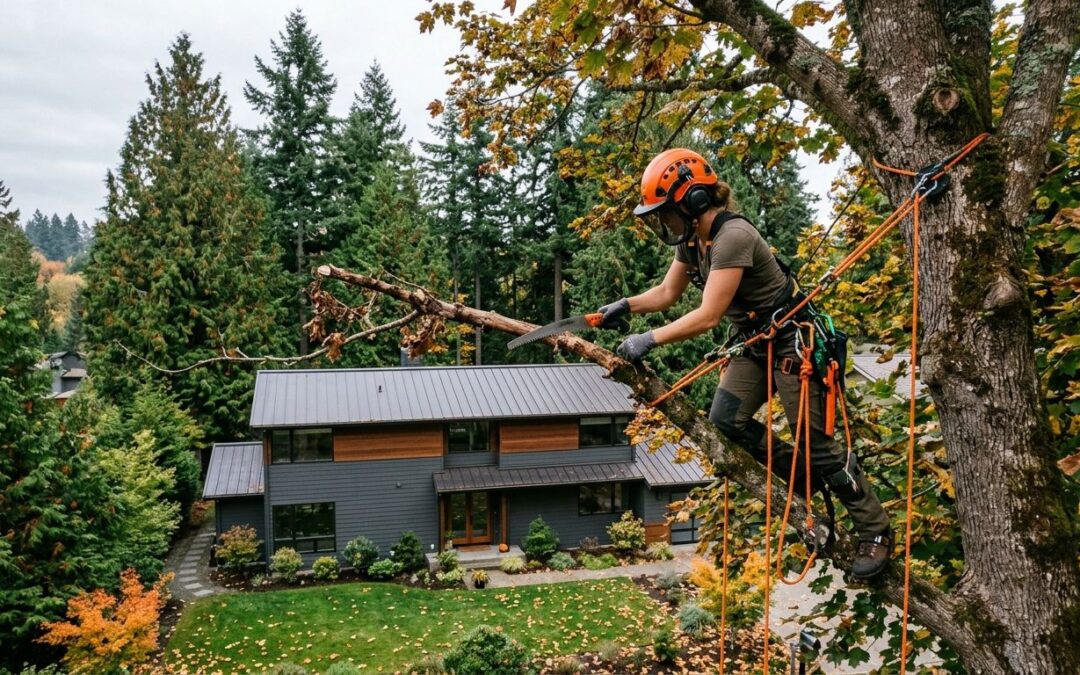
Most trees that land on a roof, a car or a fence gave warning first. A dead limb, a new lean, a crack or a patch of mushrooms at the base. Regular tree maintenance means someone notices those signs while there is still time to act calmly.
We have cared for trees across King and Snohomish County since 2010, and the pattern is the same every storm season. The emergency calls come from trees that were never looked at. Trees on a simple maintenance routine rarely end up as emergencies.
This guide covers what that routine looks like for an Eastside property, from Bellevue and Newcastle to Sammamish and Woodinville. It explains what you can check yourself and when it is time to bring in an arborist.
A tree maintenance calendar for Eastside homes
Our mild, wet winters and dry summers set the rhythm. Here is roughly how the year breaks down:
| Season | What to do |
|---|---|
| Late fall to winter | Structural pruning of deciduous trees while they are dormant. Remove deadwood and hangers before the windstorms arrive. |
| Late winter to early spring | Prune conifers such as Douglas fir, cedar and pine. Check for winter storm damage. |
| Spring | Prune spring-flowering trees like rhododendrons and magnolias after they bloom. Watch leaf-out for thin or bare sections of canopy. |
| Summer | Water young trees through dry spells. Refresh mulch and keep it off the trunk. |
| Late summer to early fall | Walk every tree near the house and look for the warning signs below, before windstorm season starts. |
Regular pruning keeps trees healthy
Pruning removes dead, diseased or weak branches before they fail, and it lets more light and air into the canopy. Good pruning is selective. The City of Mercer Island’s pruning basics guide advises removing no more than 25% of a tree’s leaf area in total, and says less is usually better.
- Young trees benefit from light structural pruning every few years. This sets up a strong form early, when the cuts are small.
- Mature trees should be pruned only as needed, mostly to remove deadwood, reduce weight over structures and clear roofs, driveways and lines.
- Topping is not maintenance. Cutting a tree’s top back to stubs starves it, invites decay and produces weakly attached regrowth that can be more dangerous than the original limbs.
Timing matters too. Our fall and winter pruning guide covers which trees to prune in the dormant season and which to leave for later. For anything above ladder height, our tree trimming and pruning crew climbs the tree rather than driving heavy equipment across your lawn.
Inspect your trees for signs of trouble
An unhealthy tree is a failure waiting for a windy day, so look at your trees on a regular schedule. Start with the leaves. In spring and summer the canopy should be full and even. Thin patches, early fall color or bare sections usually point to root problems, insects or disease.
Then look at the structure. These are the signs we take most seriously:
- Dead or brittle limbs, especially in the upper crown
- Mushrooms or hard shelf fungus on the trunk or roots
- Vertical cracks or seams in the trunk
- Two trunks joined in a tight V
- Broken limbs hanging in the canopy
- Bark falling away over soft or hollow wood
Our guide to hazard tree warning signs walks through each of these and explains which you can judge from the ground and which need an arborist.
When a leaning tree is a problem
Plenty of healthy trees lean. They grew toward the light and are anchored for it. What matters is whether the lean is new or getting worse. Cracked or lifted soil on the side opposite the lean, exposed roots, or a gap where the trunk meets the ground mean the root plate is moving. That needs attention quickly. If the lean changed after a storm and the tree could reach your house, treat it as an emergency and call our emergency tree service.
Protect the roots you cannot see
Most of a tree’s roots sit in the top couple of feet of soil and spread well past the drip line. Root damage is one of the most common reasons a healthy-looking tree fails.
- Mulch correctly. WSU Extension’s guide to mulches suggests 4 to 6 inches of arborist wood chips. Start about 6 inches from the trunk and spread toward the drip line. Never pile mulch against the bark.
- Water young trees in summer. Our dry summers are hardest on trees planted in the last few years.
- Plan around roots during projects. New driveways, patios, trenching and regrading can sever roots on one side of a tree. The canopy may look fine for a few years before the tree declines or fails. Talk to an arborist before the excavator shows up, not after.
Remove trees that cannot be saved
Some trees are past saving, and removal is the safe call. A dead tree left standing keeps decaying, draws pests and becomes more likely to fall. It also becomes more dangerous for a climber to take down safely. After removal, the stump can be ground so the area can be replanted or used. Our tree and stump removal service handles both.
On the Eastside, even a dying or hazardous tree can need a permit, and most cities expect replacement trees. Rules differ by city, so check our Eastside permit guide before you schedule removal. We handle the permit legwork on the jobs we take on.
Trees on or near the property line
A tree on a shared boundary needs a conversation before anyone cuts. Washington’s timber trespass law, RCW 64.12.030, allows triple damages when someone cuts or injures a tree on another person’s land without authority. If a neighbor’s tree is hanging over your roof, talk to them first and get the work agreed in writing. Your attorney can advise on the details.
Tree maintenance across the Eastside and Snohomish County
We work throughout the Greater Eastside, King County and south Snohomish County. Find your city:
- Newcastle
- Bellevue
- Redmond
- Kirkland
- Issaquah
- Sammamish
- Mercer Island
- Renton
- Woodinville
- Bothell
- North Bend
- Lynnwood
- Edmonds
- Everett
- Auburn
Don’t see yours? Our full service areas page lists everywhere we work.
Tree maintenance questions
How often should my trees be pruned?
Young trees benefit from light structural pruning every few years. Mature trees only need pruning when there is a reason: deadwood, weight over a structure, clearance or storm damage. An inspection every year or two tells you which trees need work.
When is the best time for tree maintenance on the Eastside?
Late fall through winter suits most pruning of deciduous trees, because they are dormant and their structure is easy to see. Conifers are best pruned in late winter or early spring, and spring-flowering trees right after they bloom. Inspections are most useful in late summer, before windstorm season.
Is a leaning tree dangerous?
Not always. A tree that has leaned the same way for years is often stable. A new lean, or cracked and lifted soil at the base, means the roots may be failing, and the tree should be checked right away.
Do I need a permit to prune a tree?
Routine pruning usually does not need one. Heavy pruning can, because several Eastside cities treat removing a large share of the crown, or topping, as removing the tree. Our permit guide lists the limits for each city.
Put Your Trees on a Maintenance Plan
We are a family-owned tree service working across the Eastside, King County and Snohomish County since 2010. Our certified arborists are licensed, bonded and insured. We climb rather than roll heavy machinery across your lawn, which matters on established properties with mature trees and landscaping worth protecting.
Tell us about your trees and we will tell you what they need this year, and what can wait.
More on what we handle: trimming & pruning · tree & stump removal · emergency tree service · all tree services
What Our Customers Say
Keep reading
More tree care guidance from our certified arborists.
- Eastside Tree Removal Permits: Bellevue, Kirkland, Redmond & MoreCity-by-city permit rules, thresholds and a quick permit checker.
- Hazard Trees: 9 Warning Signs to Check Before Storm SeasonSpot the structural red flags that mean a tree needs an arborist.
- Fall and Winter Tree Pruning on the EastsideWhat to prune before the wet season, and what to leave alone.