Windstorm season in the Puget Sound starts in October. The trees that come down in it almost always showed signs first — most of them visible from your own yard, months earlier.
We’ve been climbing trees around King and Snohomish County since 2010, and the calls we get in November are rarely surprises. They’re trees that had a lean, a crack, or a mushroom at the base that nobody looked at in August.
Here’s what to check while the weather is still good, what those signs actually mean, and — the part most guides skip — what Seattle’s rules let you do about it once you find one.
9 warning signs to check before the wind arrives
You can spot most of these from the ground with nothing but your eyes and ten minutes. Walk the whole tree, then walk back thirty feet and look at it as a whole.
1. A lean that’s new, or soil heaving at the base
Plenty of healthy trees lean. What matters is whether the lean changed and whether the ground moved with it. Look for cracked or lifted soil on the side opposite the lean, or a gap where the trunk meets the ground. That’s the root plate starting to fail, and it’s the single most urgent sign on this list.
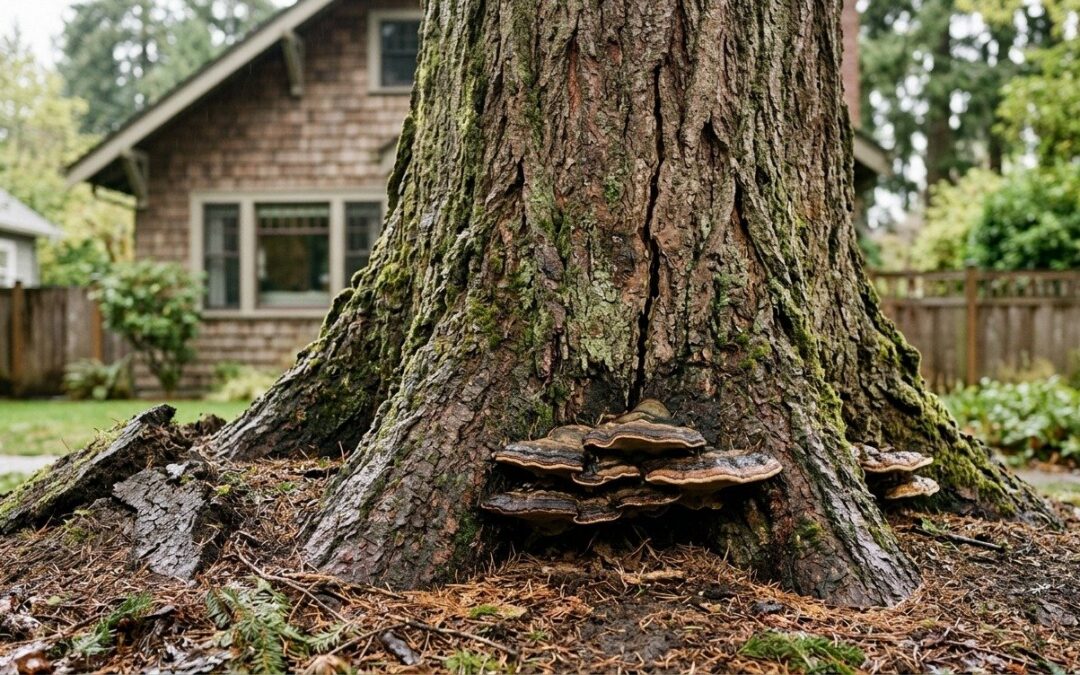
2. Mushrooms or shelf fungus on the trunk or roots
Conks — the hard, shelf-like brackets that grow out of bark — mean decay is already well established inside. By the time a fungus fruits on the outside, the wood behind it has been breaking down for a while. Fungus at the base is more serious than fungus high up, because it points at the roots.
3. Deadwood in the upper crown
Bare, brittle limbs at the top while the lower canopy is still green usually means the tree is losing the fight from the top down. It’s also the deadwood most likely to come out in a gust and land somewhere expensive.
4. Two trunks joined in a tight V
Where two stems split off at a narrow angle, bark can get trapped in the join instead of the wood knitting together. It looks fine until a windstorm loads it sideways. Wide, U-shaped forks are far stronger than narrow V-shaped ones.
5. Vertical cracks or seams in the trunk
A crack running up and down the trunk, especially one you can slide a finger into, means the trunk is already separating. Cracks that open and close as the tree moves in wind are worse than static ones.
6. Hangers — broken limbs caught in the canopy
A limb that broke but never reached the ground is stored energy sitting over your yard. These come down without warning and they don’t need a storm to do it.
7. Cedar flagging and dieback
Western red cedars across the Puget Sound have been browning from the top down. Some of that is normal seasonal flagging — inner needles turning and dropping. What isn’t normal is a dead top with green still on the lower branches. Researchers are still working out the causes, so be skeptical of anyone who offers you a confident cure. The question worth answering is narrower: is this tree now a safety problem, or just an ugly one?
8. Missing bark or a hollow that sounds different
A patch where bark has fallen away and the wood underneath is soft, or a spot that sounds hollow when you knock, means loss of the structural shell. Trees can live a long time with hollows — but a hollow on the side facing your house is a different conversation than one facing the woods.
9. Roots cut by recent work
New driveway, new patio, trenching for utilities, regrading. If someone cut roots on one side of a mature tree in the last few years, the anchoring on that side is compromised even though the canopy still looks perfect. This is the sign homeowners almost never connect, and it’s the reason some trees fail in their first big storm after a remodel.
Which of these you can judge yourself, and which you can’t
Deadwood, hangers, and obvious cracks are honest DIY observations. You’ll know them when you see them.
Root-plate movement, decay behind a conk, and the real strength of a co-dominant union are not things you can assess from the ground with any confidence — including us, without getting into the tree. That’s the line. If what you’re seeing is on the second list, the next step is an inspection, not a decision.
Finding a hazard is only half of it — the rules matter too
Here’s what surprises most Seattle homeowners: deciding a tree is dangerous doesn’t automatically mean you can take it down.
Seattle replaced the old “exceptional tree” language in 2023 with a four-tier system under the city’s tree protection code. In broad strokes, tiers are set by trunk size measured at standard height, plus heritage status and species:
| Tier | What it covers |
|---|---|
| Tier 1 | Designated Heritage Trees |
| Tier 2 | Roughly 24 inches diameter and up, tree groves, and certain species below that size |
| Tier 3 | Roughly 12 inches up to 24 inches |
| Tier 4 | Roughly 6 inches up to 12 inches |
For the biggest, most protected trees, hazard is essentially the only route to removal outside of a development permit. And that route has its own requirements: a documented tree risk assessment on the city’s required form, review and approval by SDCI, and replacement planting even though the tree was dangerous.
There’s also a public notice period before removal, so this is not a same-week process unless the situation is a genuine emergency.
Two more things worth knowing:
- Seattle changed the code again in January 2026, revising how tree protection areas are measured. Guides written before that are out of date — check the city directly rather than trusting a blog post’s numbers, including this one.
- Commercial tree work on private property in Seattle has to be done by a provider registered with the city. You can look up any company for free before you hire them. It protects you, not just the contractor — unpermitted work on a protected tree is the homeowner’s problem.
Start at the city’s own pages for tree removal permits and trees and codes.
Every city on the Eastside is different
Seattle gets the attention, but the rules change the moment you cross a city line — different diameter thresholds, different annual allowances, different replacement ratios. A tree you could remove in one city needs a permit and three replacements in the next.
We work across King and Snohomish County and handle the permit legwork on these jobs — measuring, checking your lot’s allowance, and coordinating replacements. Find your city:
- Bellevue
- Kirkland
- Redmond
- Sammamish
- Issaquah
- Mercer Island
- Renton
- Auburn
- North Bend
- Bothell
- Woodinville
- Edmonds
- Lynnwood
- Everett
Don’t see yours? Our full service areas page lists everywhere we work.
If a tree comes down anyway
Storms win sometimes. If a tree or limb fails on your property:
- Stay away from it, and assume any line it’s touching is live
- If it’s on or near power lines, call the utility before anyone else
- Photograph everything before it’s moved — your insurer will want it
- Don’t start cutting. A fallen tree is under tension in ways that aren’t obvious, and that’s how people get hurt after the storm rather than during it
Then call us. Our emergency tree service covers storm damage, fallen limbs, and hazardous trees that can’t wait for business hours.
The best time to do this is now
Inspect in late summer, act in early fall, and by the time the first real windstorm arrives the work is behind you. Wait until November and you’re calling every tree company in the county on the same afternoon as your neighbors.
If the fix is pruning rather than removal, note that the ideal pruning window here runs from late fall into winter — we cover the timing in Fall Pruning Essentials in Seattle. Structural work to reduce storm risk is worth doing on its own schedule, though.
Get a Set of Eyes on It
We are a family-owned tree service working across King and Snohomish County since 2010 — certified arborists, licensed, bonded and insured. We climb rather than roll heavy machinery across your lawn, which matters on established properties with mature trees and landscaping worth protecting.
If something on this list describes a tree in your yard, have it looked at while there is still time to do the work calmly.
More on what we handle: tree & stump removal · trimming & pruning · all tree services
Keep reading
More tree care guidance from our certified arborists.
- Get Professional Tree Maintenance to Prevent Property DamageRoutine care that heads off storm damage and liability.
- Should I Plant Trees Myself or Request Professional Assistance?Where DIY planting works, and where it quietly costs more.
- Fall Pruning Essentials in SeattleWhat to prune before the wet season, and what to leave alone.