Whether you need a permit to remove a tree in Snohomish County depends on the city. Mill Creek, Lynnwood, Mukilteo, Brier, Woodway and the city of Snohomish require one for most trees above a set size. Bothell, Edmonds and Everett usually don’t for homeowners on developed lots, unless the tree is in a critical area. Unincorporated Snohomish County has no general tree permit.
Updated November 2026 by the certified arborists at Integrity Tree Works. We check these rules before we quote any removal in Bothell, Mill Creek, Lynnwood, Edmonds and Everett.
This guide is for homeowners removing trees on an existing lot. Development projects follow different rules. Each section links to the city’s own code and permit pages so you can confirm the details. If you’re in Bellevue, Kirkland, Redmond or elsewhere on the Eastside, see our Eastside tree removal permit guide.
Snohomish County tree permit rules by city
| City | Permit to remove a healthy tree on a developed home lot? | Regulated size | Main exception |
|---|---|---|---|
| Bothell | No, on lots of half an acre or less | Over 8 in. diameter, measured at 4 ft | Larger lots and critical areas |
| Mill Creek | Yes | 6 in. and up, measured at 4.5 ft | Trees in buffers need a permit at any size |
| Lynnwood | Yes, with a fast Class I permit on lots under 16,000 sq ft | 6 in. and up, measured at 4.5 ft | Class I covers 2 trees or 40% a year |
| Edmonds | No, on a lot that can’t be subdivided | 6 in. and up, measured at 4.5 ft | Trees 30 in.+ protected through April 2027 |
| Woodway | Yes, with a yearly limit by zone | 8 in. and up, measured at 4.5 ft | Trees 30 in.+ only as hazards |
| Brier | Yes | 8 in. and up, measured at 4.5 ft | Minor permit covers 5 trees in 4 years |
| Mountlake Terrace | Ask the city first | Deciduous 6 in.+, conifers 7 ft+ tall | Critical areas |
| Mukilteo | Yes, free | Evergreens 8 in.+, deciduous 12 in.+ | Topping is banned |
| Everett | No | None set for homeowners | Lots within 300 ft of a critical area |
| City of Snohomish | Yes, free | 8 in. and up | 2 trees a year on lots under ¼ acre |
| Unincorporated county | No | None set for existing lots | Native growth protection areas |
Diameter is measured 4.5 feet above the ground (diameter at breast height, or DBH) in every city on this list except Bothell, which measures at 4 feet.
Rules that apply in every city
- Critical areas. Every city here and the county regulate trees in wetlands, streams, steep slopes and their buffers. A tree you could remove freely in the middle of a yard can need approval if it stands near a creek or ravine.
- Dead and hazard trees. Most codes exempt them, but many still expect an arborist’s assessment, photos or notice to the city, especially in critical areas. Some require replacement trees.
- Replacement trees. Several cities require new trees when a protected or hazard tree comes down, usually planted within a year. We can plant them as part of the job.
- Your plat. Many subdivisions recorded native growth protection areas or trees to be retained when they were approved. Those restrictions stay with the property when it sells.
Do you need a permit to remove a tree in Bothell?
Usually not, if your developed lot is half an acre or less. Bothell exempts tree removal on those lots from its clearing permit, as long as no bulldozer-type equipment is used. The same code applies on both the King County and Snohomish County sides of the city.
- Larger lots: the exemption covers only ornamental and landscape trees. Bothell’s code says Douglas fir, hemlock and cedar are not ornamental, so removing them can need a permit.
- Significant tree: over 8 inches in diameter at 4 feet above grade. Alders and cottonwoods don’t count.
- Exempt: dead and diseased trees, and emergency removals.
- Critical areas: removing vegetation needs city approval. A hazard tree needs a report from a certified arborist, landscape architect or forester, plus two replacement trees for each one removed, planted within a year. If the danger is imminent, you can act first and file a restoration plan within 14 days.
- Possible change: a draft urban forest plan reviewed by the Planning Commission in 2025 proposes phasing in a permit for removing private trees outside development. It has not been adopted.
Official sources: BMC 12.12 · BMC 12.18.030 · BMC 14.04.150 · Our Bothell tree service page
Do you need a permit to remove a tree in Mill Creek?
Yes, for any tree 6 inches or more in diameter, measured 4.5 feet above the ground. Mill Creek has the strictest rules in this guide for everyday removals.
- Buffers: any tree in a critical area buffer, roadway buffer or property buffer needs a permit, whatever its size. Many Mill Creek subdivisions back onto greenbelts.
- Clearing: a permit is also required to clear more than 500 square feet of natural vegetation.
- Prohibited areas: no cutting on slopes of 25% or more, within 100 feet of the bank of a year-round stream, or in critical areas and their buffers, except as the city approves.
- Dead trees: the code exempts obviously dead or diseased trees, but on developed lots it excludes significant trees and trees designated for retention. Check with the city before removing a dead tree 6 inches or larger.
- Hazard trees in critical areas: you need written approval first, a report from a certified arborist or registered landscape architect, and two replacement trees for each tree removed.
- Emergencies: allowed without prior approval. Photograph the tree first and notify the city beforehand if you can.
- Pruning needs no permit.
- How to apply: online at MyBuildingPermit.com. The city may ask for an arborist report.
Official sources: City of Mill Creek tree permit · MCMC 15.10 · Our Mill Creek tree service page
Do you need a permit to remove a tree in Lynnwood?
Yes, for most trees. On a developed single-family lot under 16,000 square feet, Lynnwood’s Class I permit lets you remove up to two significant trees a year, or 40% of them if that is more.
- Class I fee: $75 in 2026 when a site inspection is needed.
- Class II permit: required for larger lots and for removals beyond the Class I allowance. It includes staff review and replacement trees.
- Significant tree: 6 inches or more in diameter. Black locust, cottonwood, native alder, native willow and Lombardy poplar don’t count at any size.
- Replacement: trees removed beyond the Class I allowance are replaced one for one, with new trees at least 4 feet tall.
- Exempt: dead or diseased trees, and trees that threaten to become a danger to people, once the city reviews them.
- Topping: prohibited for evergreen conifers.
- Critical areas: Lynnwood adopted a new critical areas chapter, LMC 8.10, in August 2026. Check with the city before working on a tree near a wetland, stream or steep slope.
“The guys over at Integrity came and did 3 black locust trees (if you know these you hate them too with all the thorns and how large they get).”
Joseph L., September 2026 review. Black locust is one of the species Lynnwood doesn’t count as significant.
Official sources: LMC 17.15 · City of Lynnwood tree removal regulations · LMC 8.10 · Our Lynnwood tree service page
Do you need a permit to remove a tree in Edmonds?
Not on an improved single-family lot outside critical areas, with one big exception: trees 30 inches or more in diameter. Edmonds moved its tree code to ECDC Chapter 17.130 in January 2026.
- Improved lot: one that can’t be subdivided further. If your lot could be split, removals need a Type I permit.
- Landmark trees: interim rules bar removing trees 30 inches or larger unless they qualify as a hazard or nuisance. The single-family exemption doesn’t apply to them. The City Council extended these rules in September 2026, and they now run to April 2027 while a permanent code is written.
- Significant tree: 6 inches or more in diameter at 4.5 feet.
- Hazard trees: outside critical areas, removal is allowed with a tree risk assessment from a qualified professional. In critical areas, the arborist report is due before cutting, or within 14 days if the risk is imminent.
- Replacement when a permit is required: one tree for trees 6 to 10 inches, two for 10 to 14 inches, and three for 14 to 24 inches. Trees over 24 inches are covered by a fee based on an appraisal.
- Topping counts as tree removal under the code. Illegal topping can bring a five-year pruning schedule, and illegal removal fines start at $1,500 per tree.
“Susie (the arborist) was phenomenal! She immediately saw the issues and submitted the tree removal w/ the city of Edmonds for their removal.”
Victoria W., Edmonds homeowner, September 2026 review
Official sources: ECDC 17.130 · ECDC 23.10.080 · Interim landmark tree rule extension (Everett Herald) · Our Edmonds tree service page
Do you need a permit to remove a tree in Woodway?
Yes, for any tree 8 inches or more in diameter, measured 4.5 feet above the ground. On a developed lot, Woodway issues a routine maintenance tree permit with a yearly limit that depends on your zone.
- Yearly limits: 3 trees a year on R-43 lots (2 in setbacks next to a public right-of-way), 1 a year on “Figure A” lots, and 8 a year on R-87 lots. Hazard, emergency and dead trees don’t count toward the limit.
- Exceptional trees: trees 30 inches or more in diameter can only come down as hazard trees, or under a tree management permit or agreement with the town.
- Exempt species: laurel, English holly, Leyland cypress and fruit trees, if removed by hand and light equipment outside critical areas.
- Critical areas and slopes: removal is prohibited on lots with critical areas and their buffers, except hazard trees and approved plans. Trees within 50 feet of the top of a steep slope need a tree management permit.
- Hazard trees: need photos or a certified arborist report showing the hazard can’t be fixed with proper tree care.
- Emergencies: the tree can come down right away, with the permit application filed within 14 days.
- Replacement: plant at least half as many trees as you remove each year, at least 3 feet tall (6 feet in buffers, right-of-way setbacks and on Figure A lots).
- Topping: a permit is needed to top exceptional conifers and trees in right-of-way setbacks.
Official sources: WMC 16.12 · Woodway Municipal Code (eCode360) · Town tree permit information
Do you need a permit to remove a tree in Brier?
Yes, for any significant tree, which Brier defines as 8 inches or more in diameter, measured 4.5 feet above the ground. There is no permit-free allowance.
- Minor permit: covers five or fewer significant trees in a 48-month period, and expires after 60 days.
- Major permit: required for six or more trees in 48 months, for removals tied to development, and for any tree in a critical area or its buffer.
- Don’t count: alder, cottonwood, black locust and Lombardy poplar, at any size.
- Damaged, diseased or defective trees: exempt unless they are in a critical area, but an arborist has to document the tree’s condition before it comes down.
- Emergencies involving immediate danger to people or property are exempt.
- Replacement: two new trees for each one removed under a major permit, at least 3 inches in diameter for deciduous trees or 8 feet tall for evergreens.
- Topping protected and significant trees is prohibited.
Official sources: BMC 17.52
Do you need a permit to remove a tree in Mountlake Terrace?
Ask the city before you cut. Mountlake Terrace updated its tree code in 2024 and has said the new rules mainly apply to development and redevelopment, but the code’s language on significant trees is broad.
- Significant tree: deciduous trees 6 inches or more in diameter, and conifers 7 feet tall or more.
- Critical areas: no trees may be altered or removed from a critical area or its buffer without prior approval. Topping healthy trees there is not allowed.
- Hazard trees in critical areas: require documentation from a qualified professional and replacement planting.
- Heritage trees: owners can nominate trees over 36 inches in diameter for voluntary heritage protection.
Official sources: Trees for Terrace · MTMC 19.130 · MTMC 16.15
Do you need a permit to remove a tree in Mukilteo?
Yes, for evergreens 8 inches or larger in diameter and deciduous trees 12 inches or larger. A standard tree permit costs nothing under the city’s 2026 fee schedule.
- Critical areas and native growth protection areas: a permit is required for any tree, regardless of size. Trees that stabilize steep slopes can also need a geotechnical report.
- Emergencies: a tree that is an immediate threat can come down first, with the permit obtained afterward.
- Topping is prohibited. Pruning within the city’s limits needs no permit.
Official sources: City of Mukilteo tree permits · Master fee schedule
Do you need a permit to remove a tree in Everett?
Not for most homeowners. Everett has no general tree removal permit for private lots. Its rules apply to critical areas, which take in much of the city’s bluffs, ravines and stream corridors.
- Critical areas: the rules cover lots that contain a critical area or sit within 300 feet of one. Pruning trees in a critical area needs a permit. No more than a third of the crown can come off, and topping is banned except under power lines.
- Hazard trees in buffers: each tree removed is replaced with two native trees within a year. The city may ask for an arborist’s risk assessment.
- Required landscaping: trees that a property’s approved landscape plan depends on must be replaced if removed, and topping them is prohibited.
Official sources: EMC 19.37 · Everett hazardous tree handout · Our Everett tree service page
Do you need a permit to remove a tree in the city of Snohomish?
Yes, but it’s free. Since 2025, single-family homeowners in the city of Snohomish apply for a no-charge tree permit and can remove a set number of significant trees (8 inches and up) each year.
- Allowance: on lots under a quarter acre, 2 significant trees a year and 4 in five years. The allowance rises with lot size, up to 10 a year (16 in five years) on lots of 2 acres or more.
- New rules: the city replaced its old tree chapter in 2025 (Ordinance 2516, now SMC 14.120). Older pages describing a one-tree-a-year rule are out of date.
Official sources: SMC 14.120 · Ordinance 2516 (April 2025 council agenda)
Do you need a permit to remove a tree in unincorporated Snohomish County?
Usually not. Outside city limits, Snohomish County has no general tree permit for homeowners. Its rules apply to protected areas, critical areas and larger acreage.
That covers communities outside city limits such as Maltby, Clearview, Silver Firs, Martha Lake, Picnic Point, Lake Stickney, Mill Creek East, Three Lakes and Cathcart. Boundaries change with annexations, so confirm whether your address is inside a city.
- Protected areas: trees in a native growth protection area (NGPA), a critical area protection area (CAPA) or a county-approved landscape plan can’t be cut without the county’s approval first.
- Critical areas: clearing trees that aren’t hazards in a critical area requires a land disturbing activity permit.
- Hazard trees: the county says these don’t need a permit, even in a critical area. It asks for replacement at three to one with native species and an assessment by a qualified arborist. In an NGPA or CAPA, its guidance is to fell the tree into the protected area and leave the stump.
- Lots of 2 acres or more: personal-use cutting outside critical areas is limited to 5,000 board feet a year before forest practice rules apply.
Official sources: NGPA/CAPA FAQ · Bulletin #50 · Bulletin #52: hazardous trees
Other Snohomish County cities
Further north and east, tree rules mostly apply to development and critical areas, and they vary a lot. Check with your city before removing a large tree:
- Arlington: the city says tree removal requires approval and a permit before cutting. Its tree form treats conifers 12 inches and up and deciduous trees 8 inches and up as significant. See Arlington code violations.
- Lake Stevens: each residential lot has to keep a minimum number of trees, two or three depending on zone. See LSMC 14.76.
- Marysville and Monroe: their tree and clearing rules focus on development and critical areas. See Marysville 22C.120 and Monroe 22.86.050.
How we handle a tree removal permit
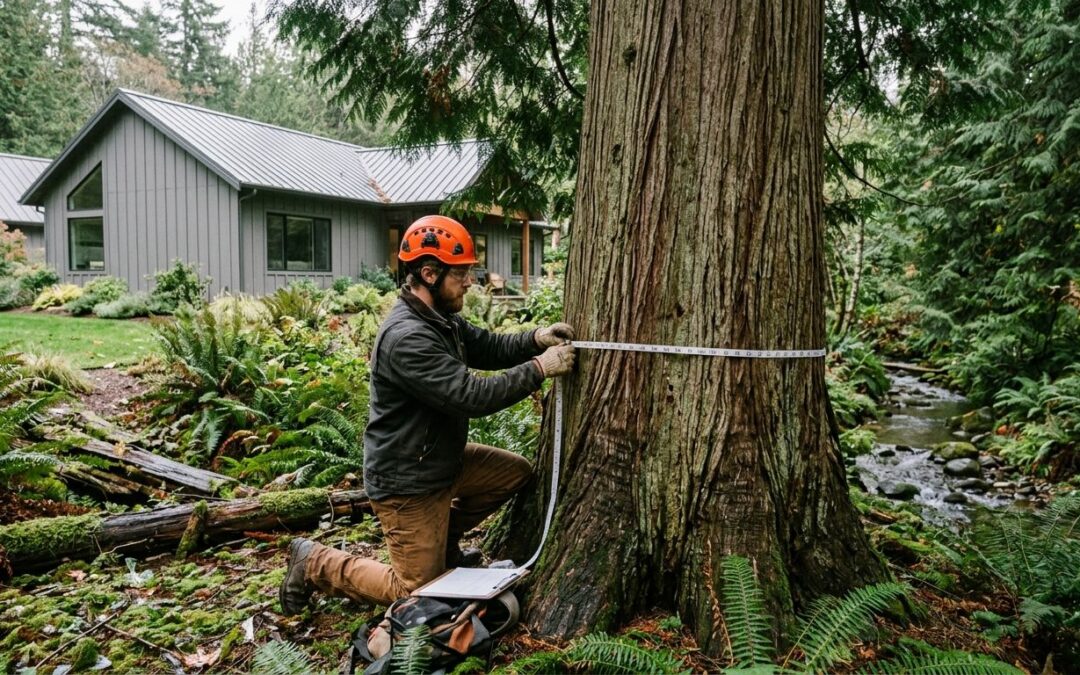
- Measure the tree. We record its diameter at the height your city uses, and its species.
- Check the property. We look for critical areas, buffers, steep slopes, nearby streams and plat restrictions.
- Assess risk. If the tree may be a hazard, our certified arborists document it in the form the city expects. Sometimes the answer is that the tree is healthy and only needs pruning.
- File the paperwork. We prepare the application and plan any replacement trees.
- Plant replacements. If the city requires new trees, our tree planting crew can put them in.
- Do the work. Our crews climb rather than drive heavy machinery across your lawn, then grind the stump and clean up.
From recent customer reviews:
“One had the top blown off in a storm and we needed it assessed for damage and health. … They do not use spikes to climb the trees which was a plus for us.”
Stacy D., October 2026 review
“The tree he was felling was a very tall, multi-trunked cedar that was right up against power and phone lines. They dropped it without any issues and cleaned everything up afterward.”
Mark M., November 2026 review
“They removed a dead tree from our front yard and replaced it with a healthy young tree.”
Frank G., November 2026 review
Snohomish County tree permit FAQ
Do I need a permit to remove a tree in Snohomish County?
It depends on the city. Mill Creek, Lynnwood, Mukilteo, Brier, Woodway and the city of Snohomish require permits for most trees above a set size. Bothell, Edmonds and Everett usually don’t for homeowners outside critical areas. Unincorporated Snohomish County has no general tree permit but protects native growth areas and critical areas.
How do I measure a tree’s diameter?
Wrap a tape measure around the trunk 4.5 feet above the ground (4 feet in Bothell) and divide the circumference by 3.14. A trunk measuring 19 inches around is about 6 inches in diameter.
Can I remove a dead or hazardous tree without a permit?
Often, but not always. Most codes exempt dead or dangerous trees, but many expect an arborist’s assessment or notice to the city, especially in critical areas, and some require replacement trees. In Mill Creek, dead trees 6 inches or larger on developed lots can still need approval.
What if my tree is near a wetland, stream or steep slope?
Expect a review. Every city in this guide and the county regulate trees in critical areas and their buffers, and many require a permit there regardless of the tree’s size.
Is tree topping allowed in Snohomish County?
Often not. Mukilteo prohibits topping, Brier prohibits topping significant trees, Lynnwood prohibits topping evergreen conifers, Edmonds treats topping as tree removal, and Everett bans it in critical areas except under power lines. Topping also weakens trees, so we don’t recommend it.
Bothell is in two counties. Do the rules change?
No. Bothell’s city code applies the same way on both the King County and Snohomish County sides.
Tree service in south Snohomish County
Not Sure Which Rules Apply to Your Tree?
Integrity Tree Works is a family-owned tree service working across King and Snohomish County since 2010. Our certified arborists are licensed, bonded and insured.
Send us a few details about your tree and we’ll tell you what your city requires before we quote.
More on what we handle: tree & stump removal · trimming & pruning · emergency tree service
Rules checked against each city’s municipal code and official pages in November 2026. Codes change, so confirm with your city before you cut.
What Our Customers Say
Keep reading
More tree care guidance from our certified arborists.
- Eastside Tree Removal Permits: Bellevue, Kirkland, Redmond & MoreCity-by-city permit rules, thresholds and a quick permit checker.
- Tree Maintenance on the EastsideA year-round plan that heads off storm damage and liability.
- Hazard Trees: 9 Warning Signs to Check Before Storm SeasonSpot the structural red flags that mean a tree needs an arborist.
Tree service near you
We work throughout the Greater Eastside, King County and Snohomish County.